
-
Translate
 TH
TH EN
EN JP
JP CN
CN
TH EN JP CNA fire protection system is a system designed to prevent and control fire incidents in buildings, factories, hotels, or public facilities. It is one of the requirements per the Engineering Institute of Thailand under Royal Patronage, and every building should install it for the safety of life and property.
Fire protection systems have become increasingly critical today because fires can arise at any moment—whether from electrical equipment, machinery, or user negligence. Installing a standard-compliant fire protection system allows fire to be detected, suppressed early, prevents spread, minimizes damage, and instills confidence in those residing or working within the building.
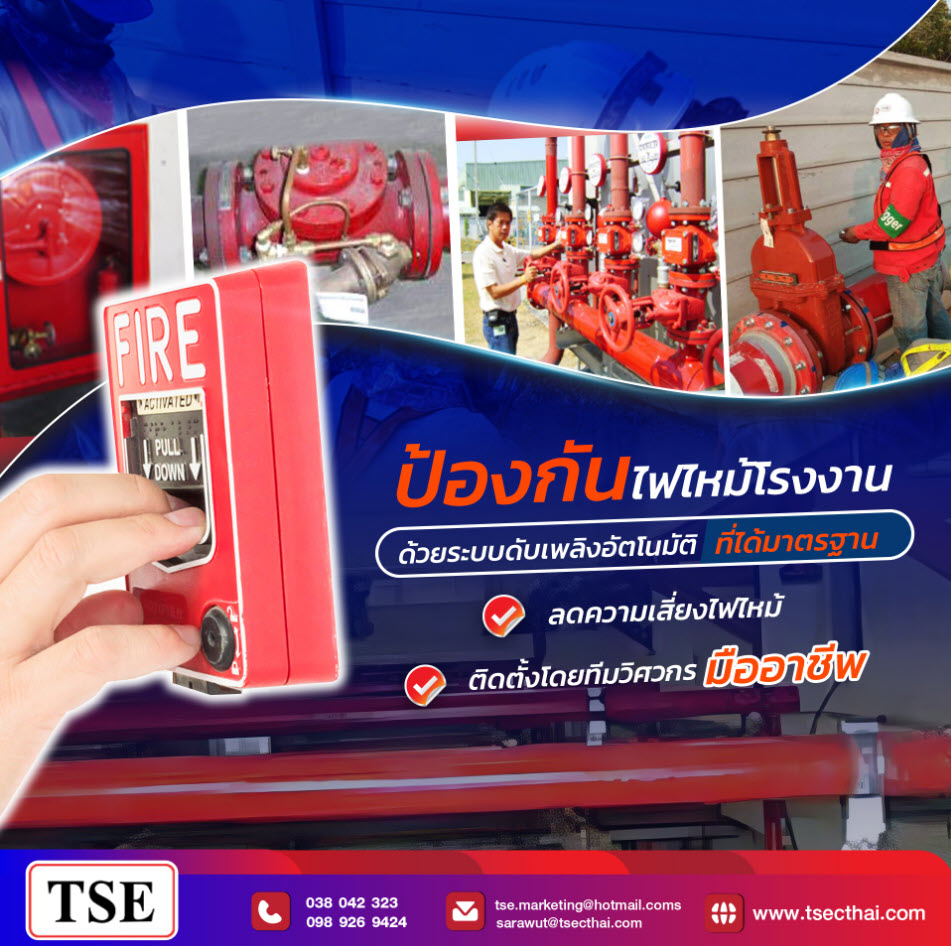
An automatic fire protection system is mainly responsible for detecting, controlling, and extinguishing fire automatically the moment it occurs. Typically, the system is triggered when smoke or heat detectors detect anomalies, then send a signal to the control panel to release the fire suppression agent into the affected area. The advantage of such systems is speed and precision—being able to control a fire from the start before it spreads to other areas, thus greatly reducing damage.
Fire protection systems play a crucial role in modern buildings—found in factories, hotels, and many other structures. It is expected that all buildings install fire protection systems according to the standards of the Engineering Institute of Thailand under Royal Patronage.
An automatic fire protection system helps prevent fires. When a fire occurs, it provides alert signals and activates suppression controls, striving to keep the fire from spreading and mitigate severe damage by extinguishing it swiftly.
The main components of an automatic fire protection system include:
- Fire suppression containers filled with agents such as FM200 or Novec‑1230, commonly used in buildings and rooms protecting electronic equipment.
- Control panel(s) that command automatic actions and monitor system status.
- Smoke and heat detectors to sense anomalies.
- Discharge devices for releasing fire suppression agent (automatic and manual) to handle various scenarios.
- Alerting components such as sirens or visual indicators in case of fire.
- Abort / shutdown devices to disable system action in case of false alarms.
All components work together in a coordinated system to maximize fire suppression effectiveness.
- Fire agent container
- Suppression agents such as FM200 or Novec‑1230
- Control and command panel
- Smoke detectors
- Automatic agent discharge devices
- Manual discharge option
- Fire alerting devices
- Abort / shutdown device
Installing a fire protection system in a building should not be overlooked. It is a critical assurance that occupants have the safety they deserve when residing or working in a structure.
Installing a fire protection system is not just about installing components. It requires expertise in electrical engineering and safety systems. The design must consider the building structure, usage patterns, fire-prone areas, and safety standards. A company with experience and specialist engineers ensures installation aligns with Engineering Institute of Thailand standards and that the system works reliably, effectively, and safely in all circumstances.
Technical System Engineering Co., Ltd. provides full-scope engineering services, especially designing and installing fire protection systems for factories and buildings, plus factory electrical systems, transformer installation, duct/vent systems, and switchboard panels.
The company’s strength lies in operations done by specialized engineers, selection of internationally standardized equipment, and correct implementation following engineering standards. Every stage—pre‑installation, during execution, and post‑handover—is managed with prompt care and service to give customers confidence. The company emphasizes work quality and continuously develops its service to meet all customer needs in safety, performance, and cost-effectiveness of investment.
Having a standard-compliant fire protection system is crucial for all types of buildings and factories to prevent fires, limit damage, and reassure occupants. If you are looking for a trusted fire protection installation expert, Technical System Engineering Co., Ltd. is the confident choice, with experience, professional teams, and reliable standards.
